
Prior to my search, the word TPACK was just a combination of letters that meant nothing to me. I hadn’t the slightest inkling at what it meant besides the assumption that the T stood for technology, as it was a term I first heard in my “Technology in the Curriculum” course. My hypothesis wasn’t very far off. However, I soon discovered that TPACK’s sole purpose isn’t just the use of technology in the classroom, but is how technology must be combined with a generous amount of content and pedagogical knowledge as well. First, I must give credit where credit is due, and therefore would like to attach the video that best described TPACK to a beginner like myself.
That said, tpack.org defines TPACK as an acronym that stands for technological pedagogical and content knowledge, and is a framework that aims to optimize students’ learning experience and teacher effectiveness in a 21st century classroom. It focuses on a teacher’s ability to know what needs to be taught (content), how it needs to be taught (pedagogy), and which device must be used (technology). To thoroughly understand TPACK, I decided to use the information collected from my sources to create a visual that housed some of my most important findings. This visual was a sketchnote, and was my first experience creating one as well.
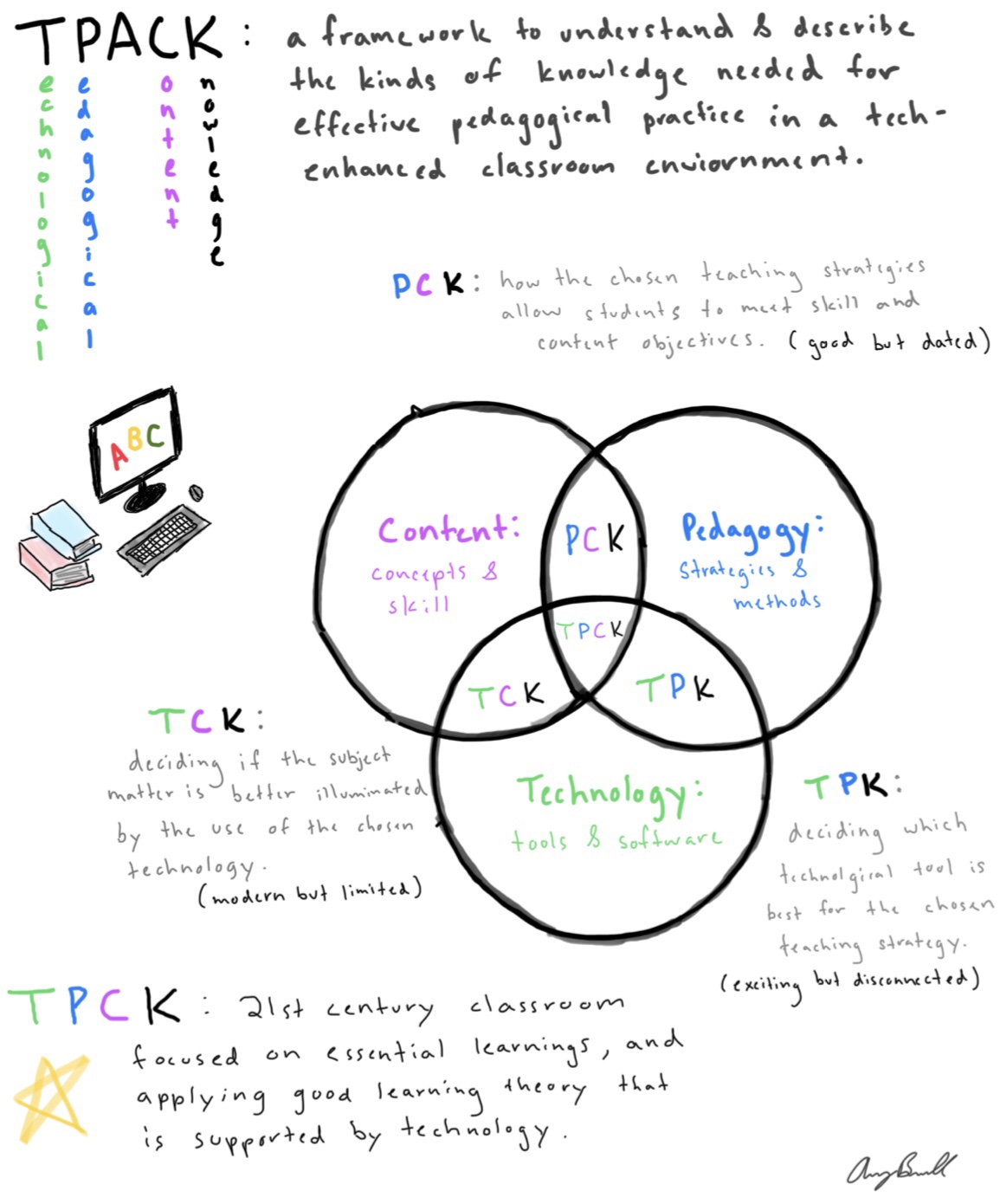
I’d like to first note that I loved every moment of creating my sketchnote, and think this is the best method for my note taking in the future, and is also a technique that I can use with my future students. I was able to combine visuals, definitions, diagrams and color coordination in a note page that is easy to follow and can be shared with anyone.
I organized my sketchnote in a strategic manner in order to make it easy to read and understand the TPACK method. I began by color coding the most important terms of the TPACK method, that is technology, pedagogy, and content. I then introduced TPACK and how it is the framework needed for a teacher to correctly integrate technology, effective teaching skills, and overall knowledge of the curriculum to create the most advanced learning environment possible. I subsequently created a Venn diagram of the three main components that was inspired by another one that I found on the Oakland Schools Literacy website. This helped me immensely because it visually depicted how just pedagogical content knowledge, or just technological content knowledge isn’t enough, and how the incorporation of all three is crucial for the 21st century classroom.
In the future, I plan to do my absolute best to adhere to the TPACK framework, as I believe it can provide limitless opportunities for my students. Especially in a special education classroom, technology is vital for helping students achieve, and simply improving their daily life. For example, the incorporation of AAC technology can give a nonverbal student the ability to speak and communicate with others. I must feed off of my students’ abilities, and select the appropriate tech to be used at the appropriate time, whether it be laptops, a SMART board activity, or the use of push button “switches” in a low functioning classroom. This technology, with the incorporation of my pedagogical knowledge, and knowledge of the content can provide my students the best possible environment and opportunities for learning.
After researching more about TPACK and creating my sketchnote, I can definitely say that my knowledge on this framework has grown immensely. I went from being completely unaware of what the acronym stood for, to being able to describe how each element of the framework must be incorporated into the classroom. That being said, I believe this experience has also provided me with a newfound love for sketchnotes and their effectiveness. This method of note taking helps combine visuals and definitions, and allows room for creativity. I believe that sketchnotes will most definitely be incorporated into my future classroom, as it will allow my students the freedom of creating their own little masterpieces while also memorizing and learning the necessary content.
 Technology in the Curriculum